
OEM Catamaran Ferry: Tailored Designs for Optimal Performance and Passenger Comfort
2026-07-21
Imagine a ferry that doesn’t just transport passengers but transforms the journey into an experience—where every hull line is optimized for speed and stability, and every seat is designed with comfort in mind. OEM catamaran ferries are redefining maritime travel, and with Allheart, tailoring these vessels to precise operational needs becomes a reality. But what truly goes into crafting a catamaran that balances performance with plush passenger spaces? Dive in to discover how bespoke engineering is charting a new course for ferry services worldwide.
Crafting Hulls Around Routes: Custom Builds for Real-World Demands
Every waterway tells a different story, from narrow winding canals to open coastal swells. That's why we shape each hull to match the demands of its intended route—no off-the-shelf solutions, just thoughtful engineering rooted in where you’ll actually sail. By studying local conditions, usage patterns, and performance expectations, we create hulls that feel like they were grown for the journey, not just manufactured.
Our design process starts with conversations, not catalogs. We learn about the waters you navigate, the loads you carry, and the weather you face. Then we blend modern composites with time-tested craftsmanship to build hulls that strike a rare balance: sturdy enough for commercial duty, yet agile enough to make every voyage feel effortless. The result is a hull that rides the waves precisely the way you need it to.
What sets these builds apart is how they disappear into the experience. The hull does its job so seamlessly that you forget it's there—no slapping, no pounding, just quiet efficiency. From ice-strengthened workboats to shallow-draft ferries, each design is a direct answer to a specific challenge. When the route changes, so does the hull, because we believe the best boat is the one that fits your water like a second skin.
Stability Meets Speed: The Twin-Hull Advantage in Ferry Design
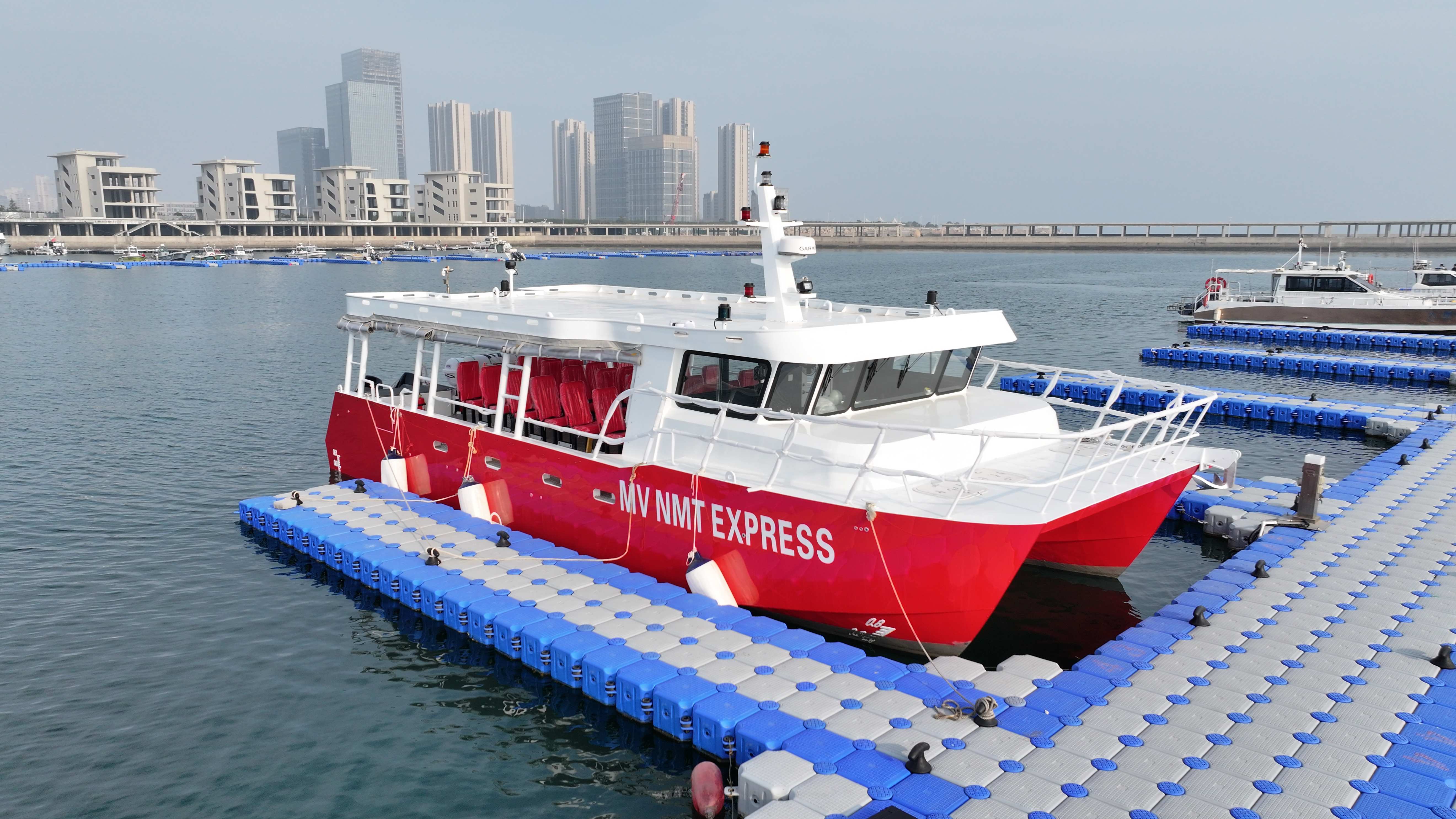
The dual‑hull architecture fundamentally alters how a vessel interacts with the sea. Instead of a single deep‑V bottom that heaves and rolls with every swell, the two slender hulls slice through the surface with reduced wave‑making resistance. This means a catamaran can maintain a steady 35‑knot cruise without the jarring slamming that fatigues passengers and stresses hull structures on monohulls. The space between the hulls creates a cushion of air that dampens pitch motion, turning what might be a rough crossing into a remarkably level ride.
Wider beam is often seen as a stability feature, but without twin hulls it brings uncomfortable snap‑roll. Catamarans pair that breadth with buoyancy spread far apart, so the righting moment is immediate and progressive. When high‑speed turns are necessary, the leeward hull digs in while the windward hull lifts only slightly, avoiding the capsize risk that limits monohull ferries in following seas. The result is a platform so stable that passengers can walk about safely, even when the vessel is sprinting across a choppy harbour mouth.
Operators quickly discover that the twin‑hull advantage extends beyond passenger comfort. Reduced drag cuts fuel consumption by up to 30% on comparable routes, and the shallow draft allows direct‑to‑shore access where deep‑keeled ships must anchor offshore. Maintenance cycles stretch out because the symmetrical hulls share loads evenly, eliminating the twisting fatigue that haunts single‑hull designs. In an industry where turnaround time and reliability determine profitability, marrying stability with speed is not a compromise—it is a quietly decisive edge.
Beyond Basic Seating: How Cabin Layouts Redefine Passenger Comfort
The subtle curve of a seatback or the width of an armrest can shape an entire journey. Airlines are moving beyond the idea that a chair is just a place to sit—they're crafting micro-environments where lighting, texture, and personal space converge. Instead of cramming rows into every inch, designers study how bodies actually rest and move. The result isn’t just extra legroom; it’s a seat that responds to you, tilting in ways that ease pressure on the lower spine during cruise. These quiet innovations turn hours in the air into something closer to a pause rather than a test of endurance.
Layouts now curve through the cabin like a conversation, not a grid. You’ll spot staggered arrangements where reading lights cascade softly over a shoulder, and partitions feel more like a book nook than a barrier. Even in economy, the angle of a tray table matters—some are sculpted to hold a tablet without straining wrists. It’s a break from the one-size-fits-all mentality. Materials play a starring role, too: breathable fabrics that shift with cabin pressure, padding that remembers your shape yet stays cool. This is comfort tethered to human instinct, not just a checklist of features.
Perhaps the truest measure is how we forget the space around us. When a cabin design works, you’re not fixated on the seat in front—you’re lost in your own rhythm, whether that’s a half-read novel or a window view of cloud peaks. Airlines that get this right borrow from architecture and even boutique hotels, using proportion to create privacy without walls. The overhead bin might be repositioned to open up headroom, while mood lighting shifts almost imperceptibly as the hours pass. It’s a quiet rebellion against assembly-line air travel, where the journey itself becomes a place to inhabit.
Powertrain Precision: Matching Engine Systems to Operational Profiles
Achieving powertrain precision means moving beyond generic engine specifications and embracing a tailored approach where every component is calibrated to the specific demands of the application. This begins with an in-depth analysis of the operational profile, including load cycles, ambient conditions, and duty requirements. By mapping these real-world variables to engine performance maps, engineers can select the optimal combustion system, turbocharging strategy, and aftertreatment layout. The result is not just an engine that runs, but one that delivers peak efficiency and responsiveness exactly where and when it is needed, whether powering a long-haul truck through mountainous terrain or a generator in a mission-critical backup scenario.
The integration of advanced electronic controls plays a defining role in this matching process. Modern engine management systems continuously adapt fuel injection timing, air-fuel ratios, and emission controls based on sensor feedback that reflects the immediate operating state. This dynamic tuning allows a single base engine to behave differently across multiple profiles—maximizing torque at low speeds for construction equipment, for example, while prioritizing fuel economy during highway cruising. Moreover, predictive algorithms leverage GPS and terrain data to anticipate load changes, further refining the powertrain response and eliminating unnecessary fuel consumption or mechanical stress.
Finally, powertrain precision extends to the entire driveline integration. The engine must harmonize with transmissions, axles, and power take-off units to ensure that power delivery aligns seamlessly with work demands. In off-highway applications, this might involve specialized gear ratios and hydraulic interfaces, while marine propulsion requires corrosion-resistant materials and cooling systems designed for constant high loads. By treating the powertrain as a holistic system rather than an isolated engine, manufacturers achieve a balance of power, durability, and operational cost that is uniquely suited to each customer’s operational profile.
Noise and Vibration: Quiet Engineering for a Smooth Journey
Modern vehicles are designed to isolate passengers from the harsh realities of the road, turning every drive into a cocoon of calm. Engineers spend countless hours fine-tuning the cabin environment, using advanced materials and clever structural designs to absorb or deflect unwanted sound waves. From the hum of the engine to the rumble of tires on asphalt, each potential disturbance is tackled at its source, ensuring that what reaches your ears is little more than a gentle whisper.
Beyond simple soundproofing, the quest for quiet involves a deep understanding of vibration dynamics. Components like the engine mounts, suspension bushings, and even the steering wheel are carefully tuned to cancel out resonant frequencies that can cause discomfort over long journeys. Lightweight yet rigid chassis structures help reduce low-frequency booms, while acoustic glass and specially layered floor mats block out wind and road noise. The result is a ride so serene that it redefines your expectations of automotive comfort.
Maintenance Made Simple: Design Choices That Lower Lifespan Costs
Too often, the conversation around product design fixates on upfront costs, leaving the real financial drain—ongoing maintenance—unaddressed. Smart design choices dispel the myth that durability requires constant, expensive upkeep. By selecting materials that resist corrosion and wear from the start, designers embed longevity directly into the product’s DNA. It’s not about over-engineering, but about anticipating where everyday stress will accumulate and reinforcing those points without adding needless complexity.
Beyond materials, the physical layout of a product dictates how much time and money maintenance crews will spend on it. Accessibility is the silent hero here: placing frequently serviced components within reach, eliminating hidden fasteners, and ensuring standard tools fit where they’re needed. When a technician can swap a worn part in minutes instead of hours, the lifespan cost plummets. This isn’t just convenience—it’s a deliberate strategy that turns maintenance from a disruptive event into a predictable, low-impact routine.
Modularity further shifts the economics in the user’s favor. Instead of scrapping an entire assembly when one element fails, a modular design allows for targeted replacements that extend the overall system’s life at a fraction of the cost. This approach demands foresight during the initial design phase, but the payoff is a product that evolves with its environment, sidestepping the typical cycle of deterioration and obsolescence. Ultimately, maintenance simplicity isn’t a feature—it’s embedded in every curve, joint, and material choice.
FAQ
It's a catamaran ferry designed and built by an original equipment manufacturer specifically to meet the unique needs of operators. Unlike standard models, every aspect—from hull shape to interior layout—can be customized for better performance, fuel efficiency, and passenger experience.
The customized hull and propulsion system are optimized for the specific routes and sea conditions the ferry will operate in. This means reduced drag, higher speed, and lower fuel consumption compared to off-the-shelf designs. Lightweight materials and advanced hydrodynamics also play a big role.
Absolutely. Tailored designs allow for optimized seating arrangements, reduced noise and vibration, better climate control, and smoother rides. We can adjust the suspension and stabilizer systems to minimize motion sickness, and design the interior with amenities that enhance the journey.
Almost everything can be customized—capacity, layout, engine type, onboard facilities, even exterior styling. You can choose specific seating configurations, add entertainment systems, incorporate accessible features, or integrate brand identity elements. The goal is to create a ferry that fits your exact operational and brand requirements.
Yes, that's the main advantage. We analyze your route conditions—distance, water depth, wave patterns, passenger volume—and design a vessel that performs optimally in those conditions. Whether it's a short urban commuter route or a longer inter-island service, the design will be adapted accordingly.
OEM catamaran ferries are built with long-term service in mind. The use of corrosion-resistant materials like aluminum or advanced composites reduces maintenance needs. Moreover, the design simplifies access to critical components, making routine checks and repairs easier and faster.
It starts with a consultation to understand your requirements. Then our naval architects create a preliminary design. Once approved, we move to detailed engineering and construction using modern shipbuilding techniques. Throughout the build, you can monitor progress and request adjustments. Delivery includes sea trials and crew training.
Conclusion
In the realm of passenger ferries, the shift toward purpose-built catamarans reflects a deeper understanding that no two routes share identical demands. OEM designers now shape hulls around specific sea conditions, operational tempos, and regional preferences, crafting vessels that slice through chop with remarkable stability while sustaining swift transit times. This twin‑hull philosophy inherently reduces roll, yet the real art lies in fine‑tuning beam, deadrise, and weight distribution to match a vessel to its daily rhythms—whether that means maximizing deck space for island‑hopping tourists or prioritizing load capacity for commuter corridors. Inside, cabins move beyond basic seating tiers; ergonomic contours, adaptable lighting schemes, and thoughtfully zoned quiet areas turn what was once a simple crossing into an experience passengers actively seek out. Sound‑dampening bulkheads and vibration‑isolated superstructures work in concert with clever layout choices, ensuring that the rumble of machinery never intrudes on the serenity of a window seat.
Behind these passenger‑centric touches, the engineering core follows the same tailored logic. Propulsion systems are chosen not by default but by examining a route’s exact speed requirements, draft limits, and fuel‑access realities, blending diesel, hybrid, or even electric drives to hit operational sweet spots. This precision curbs excess fuel burn and wear, embedding cost savings directly into the design DNA. Moreover, OEM teams integrate maintenance foresight from the keel up: accessible cable runs, standardized component clusters, and dry, reachable void spaces slash inspection times and discourage corrosion. By aligning every decision—from engine mounts that hush harmonic resonance to corrosion‑resistant alloys that laugh off salt spray—these catamarans deliver a ride that feels bespoke and remains affordable to run for decades.
Contact Us
Contact Person: Benny Hu
Email: [email protected]
Tel/WhatsApp: +8618354225697
Website: https://www.allheartmarine.com/