

OEM Stainless Steel Hex Self Drilling Screws for Corrosion-Resistant Metalwork
2026-10-29
Rust never sleeps, and neither should your fasteners. For metalwork that faces moisture, salt, or harsh chemicals, ordinary screws are a liability. That's where OEM stainless steel hex self drilling screws come in—built to drive into tough alloys and hold strong against corrosion. At Wanluo, these fasteners are manufactured to precise standards, eliminating the need for pilot holes while delivering lasting performance. In this article, we’ll explore why they’re the go-to choice for demanding projects.
Stainless Steel That Stands Up to Salt, Rain, and Time
Coastal air carries a fine, persistent mist of salt that gnaws at ordinary metals within months. This alloy shrugs it off. The chromium-rich surface forms a transparent oxide layer that, when scratched or abraded, re-forms almost instantly in the presence of oxygen—so even hairline damage from wind-blown sand doesn't become a starting point for rust. After years of exposure to sea spray and storm-driven rain, the metal remains smooth to the touch, with no pitting along welds or edges where corrosion usually takes hold first.
Rainwater, especially in industrial or urban areas, picks up sulfur and nitrogen compounds that lower its pH and accelerate rusting. Molybdenum in this stainless steel interrupts that process by making the passive film far more resistant to chloride ions—the primary trigger for pitting and crevice corrosion. That's why you'll find it used for dock cleats, handrails on oceanfront walkways, and outdoor electrical enclosures that sit under downspouts or in splash zones. It doesn't demand a coating, a paint touch-up, or a sacrificial anode to keep doing its job.
Time is the real test. Ten, twenty, thirty years of freeze-thaw cycles, UV exposure, and airborne salt deposits would leave lesser alloys streaked with brown runoff and flaking oxide. This one simply develops a matte gray sheen that many designers actually prefer. Maintenance amounts to occasional washing with plain water—not to protect it, but to remove the same grime any surface collects. The material itself isn't fighting a losing battle; it's just waiting out the seasons.
Hex Heads That Stay Put Under High Torque
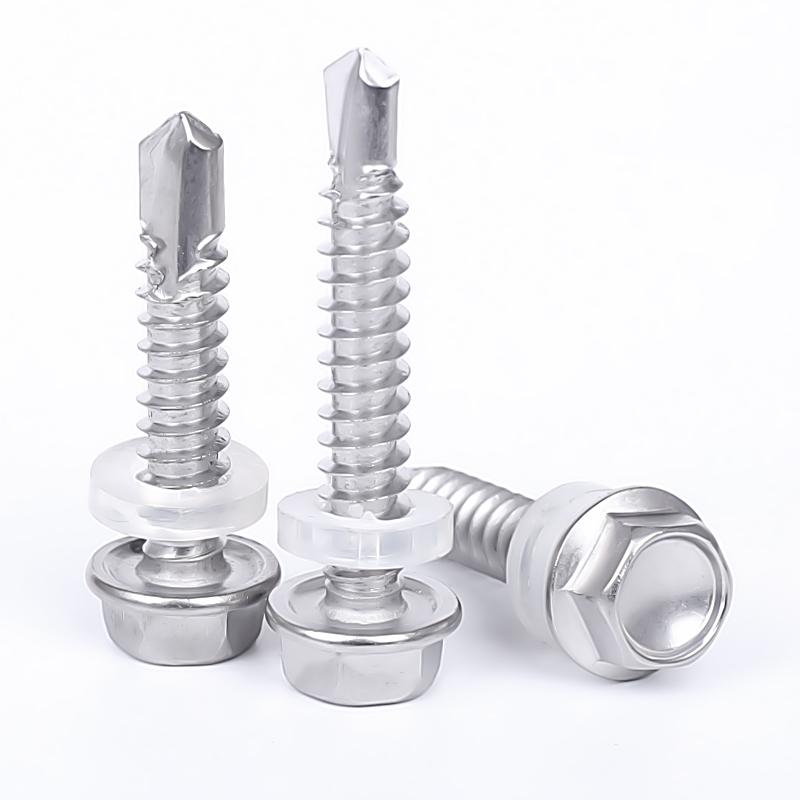
A hex head stays put under high torque for a simple reason: the wrench or socket grips the flats, not the fragile corners. That spreads the turning force over six solid contact areas, so the tool does not chew through the edges the way it can on a slotted or Phillips fastener. When a bolt has to be hit with a long breaker bar, this is the shape that survives.
Pair it with a six-point socket and the engagement gets even tighter. There is almost no slop between the tool and the head, which means less rotation before the torque goes into the fastener—and far less chance of rounding a rusty suspension bolt or an over-tightened axle nut. The head holds its shape job after job instead of slowly turning into a circle.
The metallurgy behind the head is just as important. A well-hardened hex head resists the smearing and deformation that high torque can cause, and a smooth, even finish lets the socket slide on fully. That full contact is what keeps the tool locked on when you finally get the bolt to move.
The Self-Drilling Point That Skips the Pilot Hole
A pilot hole used to be non-negotiable with standard fasteners, but this point changes that. The tip is ground to cut through steel or wood as it spins, forming its own path without any pre-drilling.
Because the screw bores and taps in one motion, you spend less time swapping drill bits. It holds its line well, even on slick metal surfaces, so the fastener doesn't wander off center.
For thin-gauge metal or dense hardwoods, skipping the pilot hole also means fewer chances of splitting or dimpling the workpiece. The point's flutes eject chips as they go, keeping the hole clean and the grip tight.
OEM Fastener Specs Matched to Your Metal Thickness
A 0.8 mm sheet doesn't need the same grip length as a 3 mm plate, yet many catalogs treat them as interchangeable. The correct OEM fastener spec starts with the actual metal thickness you're joining—not just the nominal gauge, but the measured stack-up including any coatings, shims, or pre-punched hole tolerances. Matching the thread pitch and under-head length to that real dimension prevents the two most common failures: bottoming out before clamping, or leaving a loose connection that works itself apart under vibration.
When thickness varies across a production run, a single rigid spec can create quality escapes. Instead, look for OEM fasteners with a defined grip range that covers your tolerance band, and pair them with the right thread engagement for the parent material. Thin sheet metal often performs better with fine threads or thread-forming designs that distribute load without stripping, while thicker sections can handle coarser pitches with higher torque values. The spec should also account for hole size: too large a clearance and the fastener cocked during installation; too small and you get edge cracking or cross-threading.
Beyond the basic dimensions, material hardness matters. A self-tapping screw specified for 1.2 mm cold-rolled steel may chew through soft aluminum of the same thickness unless the point style and heat treatment are adjusted. Request an OEM fastener spec that states the exact engagement length, minimum and maximum clamping thickness, and the recommended hole diameter for your metal alloy—not just a generic “works with thin metals” claim. This level of matching reduces rework, keeps torque values consistent, and extends the life of both the fastener and the assembly.
Where Corrosion Resistance Actually Comes From
Most people assume a thick coating or a shiny surface is what keeps rust at bay, but the real story is far more subtle. At its core, corrosion resistance hinges on how a material interacts with its environment at the atomic level—specifically, the formation and stability of a passive oxide layer. Stainless steel, for example, isn't inherently immune to rust; it relies on chromium atoms migrating to the surface and reacting with oxygen to create an invisible, self-healing film only a few nanometers thick. Scratch that film, and if enough chromium is present, it reforms almost instantly. So the secret isn't bulk strength or coating thickness, but a delicate, living chemical barrier that constantly repairs itself.
Another overlooked source of corrosion resistance is microstructural uniformity. Even a corrosion-prone alloy can become remarkably durable if its grains are fine, evenly distributed, and free of harmful precipitates at grain boundaries. In aluminum alloys, for instance, copper-rich particles can act as tiny galvanic cells, accelerating localized pitting. But through careful heat treatment and alloy design, manufacturers can homogenize the microstructure, reducing those galvanic hot spots. Similarly, in carbon steel, the presence of inclusions like manganese sulfide can initiate pitting, while clean, inclusion-free steel resists attack far better. So resistance often comes not from adding exotic elements, but from removing microscopic defects that would otherwise serve as corrosion initiation sites.
Finally, environmental chemistry plays a decisive and frequently underestimated role. A material that fails quickly in a marine splash zone might last decades in a dry desert or a mild alkaline solution. The key is understanding the specific ions, pH, temperature, and oxygen availability of the service environment—and then selecting a material whose passive film remains stable under those exact conditions. For example, titanium excels in chloride-rich seawater because its oxide layer is virtually insoluble in that environment, whereas ordinary stainless steel would suffer crevice corrosion. Thus, true corrosion resistance is a three-way marriage: the alloy's intrinsic passive film, its microstructural cleanliness, and the specific chemical aggressiveness of the surroundings. Get all three right, and you have a material that quietly outlasts expectations.
Field Notes for Metal Roofing, Brackets, and Cladding
Ran a quick check on the north elevation today. The 24-gauge panels looked fine at first pass, but once the sun hit, you could see the standing seams pulling slightly near the ridge. Not enough to leak, but the clip slots were bottomed out on the high side of the roof. Backed those off a turn and the panel settled without oil canning.
Bracket layout on the west wall was out by half an inch at the third line from the corner. That pushed the cladding joint past the weather lap, so we snapped a new line and shifted the Z-girts before any more panels went up. Small fix now, but it would have shown as a wave in the final face.
Also worth noting: fasteners into the hat channels were overdriven on the last lift. The washers cupped and compressed the insulation, which breaks the thermal break. Replaced the worst ones and set the driver depth to stop just shy of the rubber. Kept a few spares in the truck for the next drop.
FAQ
The hex head gives you a solid grip with a socket or wrench, while the drill point cuts through sheet metal without a separate pilot hole. That saves time on assembly lines and keeps the work surface clean.
Stainless steel resists rust far better than coated carbon steel. For coastal or marine conditions, 316 stainless is usually the better choice, but 304 works fine for most general outdoor exposure.
A hex head withstands higher torque without camming out, so you can drive the screw into harder metals. It also works with standard sockets, which most metalworking shops already have on hand.
No. The self-drilling tip creates its own hole as it turns. Just make sure the metal thickness stays within the screw's drilling capacity — usually up to about 1/4 inch for standard sizes.
Yes. OEM orders can be tailored in thread size, length, head marking, and even finish. Many buyers request specific packaging or a unique head stamp to match their brand.
Typical sizes drill through 20 to 12 gauge steel without trouble. For anything thicker than about 6 mm, you may need a screw with a higher drill point rating or a pre-punched guide hole.
Zinc plating is just a surface layer — once scratched, the underlying steel rusts. Stainless steel resists corrosion throughout the material, so even nicks and thread wear won't expose rust-prone metal.
They're common in HVAC ductwork, metal roofing, trailer bodies, and stainless steel enclosures. Anywhere you need a quick, tight connection in thin-gauge metal without a separate pilot step.
Conclusion
For metalwork that has to survive coastal salt, acid rain, or just years of damp, the alloy choice matters more than the thread pitch. These OEM stainless steel hex self drilling screws lean on the chromium oxide layer that reforms the instant a scratch exposes fresh metal. That is the actual reason they shrug off rust instead of relying on a thin zinc coating that wears away. The hex head is not there for looks; it gives a socket plenty of bite so you can drive at high torque without camming out. Meanwhile the self-drilling tip means the screw creates its own path through sheet steel, purlin, or bracket, which removes the need to line up a pilot hole and keeps the job moving when you are on a lift or a roof.
Specifications get matched to your metal thickness instead of forcing one thread style on every job. A screw meant for 0.8 mm cladding behaves differently from one that has to bite into a 4 mm bracket, and the drill point length, thread pitch, and under-head bearing all shift with that number. Out in the field, installers keep these on hand for metal roofing laps, angle brackets, and wall cladding where a failed fastener means a leak or a panel popping loose. The corrosion resistance does not come from a coating added later but from the stainless steel chemistry itself, so cut edges and drive-worn sockets stay quiet long after galvanized alternatives start bleeding rust. That is the difference between a box of screws and a fastener spec you can trust on a job that has to last.
Contact Us
Contact Person: Shane
Email: [email protected]
Tel/WhatsApp: 8613357785029
Website: https://www.wanluohardware.com

