
VS1 Vacuum Circuit Breaker 12kV Company: Your Trusted Source for Safe and Efficient Power Control
2026-10-01
Every millisecond counts when a fault current surges through your 12kV line. The VS1 Vacuum Circuit Breaker 12kV is engineered to interrupt it before damage spreads—offering the safe, efficient power control your operation can’t afford to lose. Yet not all breakers are equal. What makes the difference is the source behind them. MOLDVOLT brings you a VS1 that’s been proven in the field, not just on paper. Ready to see how?
Why the VS1’s 12kV Vacuum Interrupter Outperforms Older Breaker Designs
The VS1’s 12kV vacuum interrupter brings a level of electrical endurance that older air-magnetic or oil-based breakers simply cannot match. Because the interruption happens inside a sealed vacuum chamber, the arc is extinguished almost instantly without the need for heavy arc chutes or oil replacement. In practice, this means the contact erosion is minimal even after thousands of operations, so the breaker keeps a consistent performance curve over its life instead of degrading after each fault.
Another advantage is the reduced maintenance burden. Traditional breaker designs often require periodic inspection of contact gaps, lubrication of mechanical linkages, and testing of insulating media. With the VS1, the vacuum interrupter is sealed for life, so there is no oxidation, no moisture ingress, and no need to refill or filter oil. Field crews can go years between routine checks, and when a check is done, it is mostly visual plus a contact resistance test—not a full teardown.
Faster interruption also improves system protection. The VS1 can clear a fault in less than two cycles, limiting the let-through energy and reducing stress on downstream equipment. Older breakers often take longer or have a longer arc duration, which heats conductors and insulation. By cutting the fault current sooner, the VS1 helps prevent cascading failures and extends the life of transformers, cables, and busbars connected to the same switchgear.
A Closer Look at the Arc Extinction Process Inside the VS1
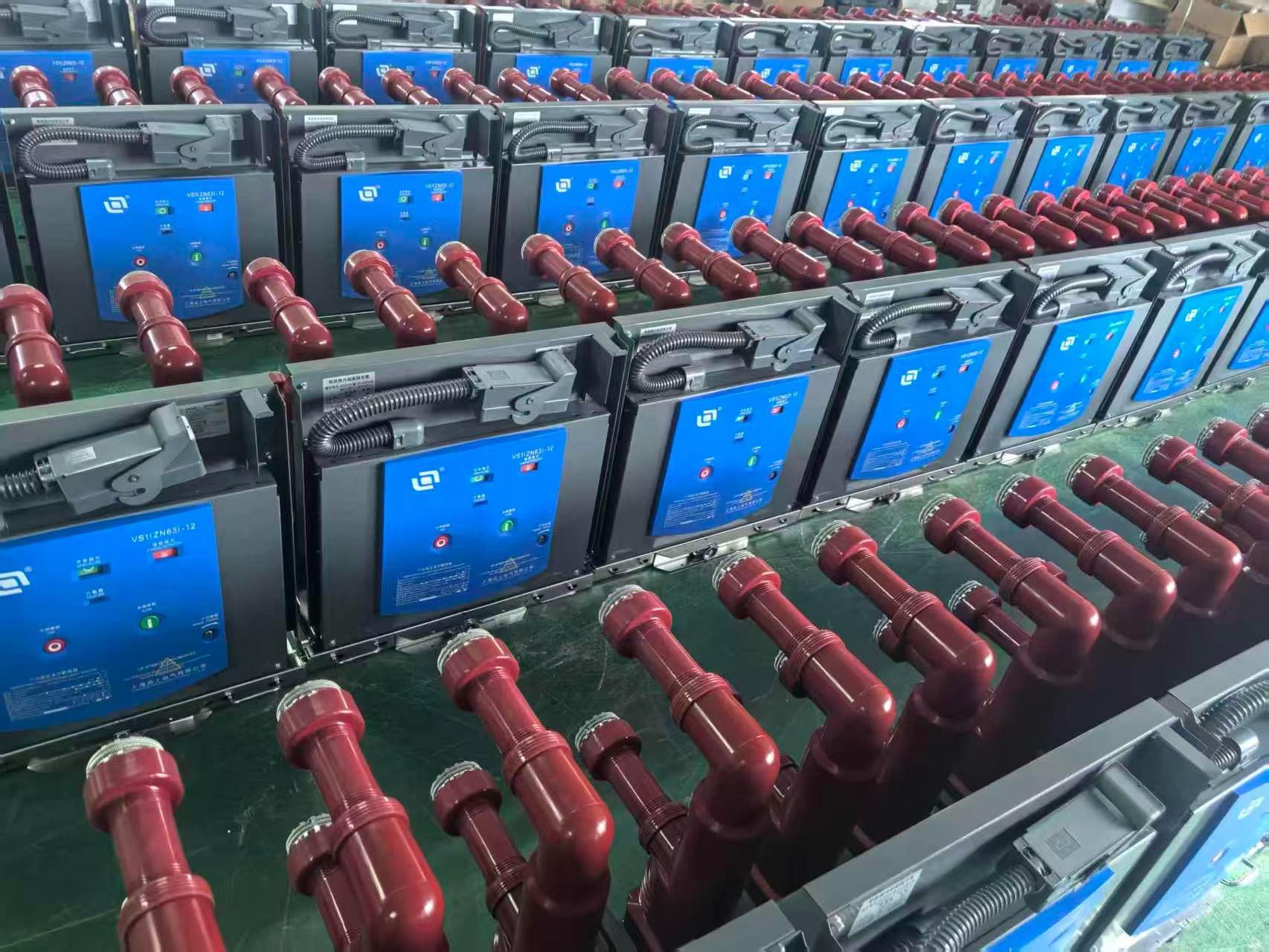
When the VS1's contacts begin to separate, the current continues to flow through a rapidly narrowing metal bridge until it ruptures, and an arc is struck inside the vacuum interrupter. Because there is no gas to ionize, the arc consists almost entirely of metal vapor and electrons boiled off from the contact surfaces. This vapor expands outward from the cathode spots, forming a plasma cloud that carries the current between the contacts. The vacuum environment itself does not extinguish the arc; instead, it provides the conditions for extremely rapid recovery once the current approaches its natural zero crossing.
As the alternating current nears zero, the energy input to the arc drops sharply. The metal vapor production slows, and the plasma begins to cool and recombine. Within microseconds, the charged particles diffuse away from the gap and condense back onto the contact surfaces or the surrounding shields. What remains is a gap with an exceptionally high dielectric strength—far higher than what you'd find in air or SF6 at the same contact separation. This quick transition from a conducting plasma to an open circuit is what allows the VS1 to interrupt fault currents without the need for elaborate arc chutes or extinguishing media.
The shape of the contacts inside a VS1 plays a decisive role here. Many designs use spiral-pattern or cup-shaped contacts that generate a magnetic field perpendicular to the arc column. That field forces the arc to rotate continuously, spreading the heat over a larger area instead of letting it linger at a single spot. In some cases, a longitudinal magnetic field keeps the arc diffuse rather than constricted, which reduces contact erosion and maintains low arc voltage. The result is a quiet, fast extinction process that leaves the interrupter ready for the next operation with minimal contact wear.
Where the VS1 12kV Breaker Earns Its Keep in Modern Substations
The VS1 12kV breaker doesn't just sit in a cubicle waiting for something to go wrong. In modern substations, it becomes the quiet workhorse of medium-voltage distribution, handling daily switching duties that would wear down lesser designs. Feeder circuits, capacitor banks, and transformer secondaries all rely on its vacuum interrupter technology to chop load current without fanfare, while the operating mechanism stays tight and predictable across thousands of close-open cycles.
Where it truly proves its worth is in the unglamorous corners of the grid: mining switchyards, cement plants, and district heating stations where dust, humidity, and temperature swings are part of the job. The VS1's sealed interrupters keep contact erosion negligible, and its spring-charged drive doesn't need compressed air or complicated hydraulics. Maintenance crews appreciate that a breaker this compact can be racked out, inspected, and put back on the bus within a single shift, not a planned outage window.
Protection schemes get a boost too. With fast arc extinction and a short arcing time, the VS1 limits fault energy downstream, sparing cables and transformers from needless thermal stress. That makes it a favorite for retrofits where older oil or air-blast breakers are finally being retired, and for new builds where floor space is tight but reliability expectations aren't negotiable.
Preventing Thermal Runaway: How the VS1 Handles Continuous Load Shifts
The VS1 doesn't just react to heat after it builds up—it actively predicts where thermal stress will concentrate as load demands change. By monitoring current flow across multiple phases in real time, the system redistributes energy before localized hotspots can form. This approach keeps internal temperatures well below critical thresholds, even when duty cycles swing from light standby to full-rated output and back again within minutes.
Continuous load shifts often create uneven heating that standard protection circuits miss until it's too late. The VS1 uses a dynamic thermal model that factors in ambient conditions, recent load history, and even minor imbalances between phases. When a drift is detected, it adjusts the switching pattern or slightly derates specific components for a short window—smoothing out the thermal profile instead of allowing a runaway feedback loop to start.
What sets the approach apart is that it doesn't rely on a single temperature sensor in one spot. Multiple sensing points feed into a control loop that sees the whole thermal picture. If one section begins to warm faster than predicted, the VS1 can preemptively shift part of the load to a cooler path or increase airflow demand. The result is a system that stays within safe operating limits without sudden emergency shutdowns or reduced lifespan from accumulated heat stress.
What Field Engineers Say About VS1 Installation and Long-Term Reliability
Field engineers consistently point to the VS1's plug-and-play setup as a standout feature. One engineer who handles mid-sized industrial sites noted that the mounting bracket alignment and pre-terminated connectors cut install time by nearly half compared to the previous generation. Instead of fiddling with loose jumpers or re-crimping during final assembly, the team could bolt the unit in place and have it passing signal within the hour.
Long-term reliability comes up just as often in post-installation debriefs. A service tech covering remote telecom towers mentioned that after two full seasonal cycles—including heavy icing and summer heat spikes—the VS1 enclosures showed no signs of moisture ingress or connector corrosion. He contrasted this with older models that needed gasket replacements every eighteen months. The consistent feedback is that the VS1 holds its tuning and doesn't drift, which means far fewer truck rolls for recalibration.
Another recurring comment is about the diagnostic LED layout. Engineers appreciate being able to glance at the unit during routine maintenance and immediately tell whether the issue is power, link, or antenna-side. That might sound minor, but in the field, time spent guessing is time not spent fixing. The consensus is that the VS1 doesn't just survive harsh conditions—it makes the follow-up work predictable.
Matching Your 12kV Protection Needs Without Overbuilding the Switchgear
Most 12kV protection schemes fail because they either under-spec the fault clearing or pack in features that will never be used after commissioning. We start with the actual short-circuit levels, load profiles, and coordination requirements from your site, then match the relay settings, CT ratios, and breaker interrupting ratings to those numbers—not to a generic catalog sheet. This keeps the switchgear lean enough to fit existing footprints, yet strong enough to handle real faults without nuisance trips.
Overbuilding often shows up as oversized busbars, redundant protection zones, or communication protocols that add cost but no operational value. By reviewing your protection curves and upstream coordination before fabrication, we trim away those extras. The result is a switchgear lineup that carries only what your 12kV network needs, backed by type-tested components and a factory witness test that proves performance at every set point.
FAQ
It uses vacuum interrupter technology, which extinguishes arcs quickly and reduces maintenance needs compared to older air or oil breakers.
Each unit goes through rigorous testing, including dielectric and mechanical endurance checks, before leaving the factory.
Usually yes, because its compact design and standard mounting dimensions match common 12kV panels, but a site survey is recommended.
Thanks to the sealed vacuum interrupters, routine maintenance is minimal—typically visual inspections and occasional contact resistance measurements.
They offer direct engineering support, customized tripping curves, and fast delivery from regional warehouses, which reduces downtime during replacements.
Yes, its mechanical endurance is rated for tens of thousands of operations, making it reliable for motor starting or capacitor bank switching.
Utilities, mining operations, data centers, and manufacturing facilities rely on it for primary distribution and transformer protection.
Conclusion
The VS1’s 12kV vacuum interrupter leaves older breaker designs behind in ways that matter under real load conditions. Instead of relying on oil or SF6, the vacuum chamber snuffs out arcs almost instantly when contacts part, with no gas to manage and no messy byproducts. That clean interruption isn't just a lab curiosity—it's what keeps continuous load shifts from turning into thermal runaway. Heat generated during switching dissipates quickly through the compact arc-quenching assembly, so the breaker holds steady even when demand spikes or sags without warning. Field engineers who've worked with both legacy and VS1 gear consistently note fewer burn marks on contacts and far less maintenance drama over multi-year service intervals.
In modern substations, the VS1 earns its keep in feeder protection, transformer switching, and capacitor bank control—places where a misstep means hours of downtime. But the real advantage is that you don't have to overbuild your switchgear to feel safe. The breaker's ratings and fault-interruption capacity align closely with typical 12kV distribution needs, so you pay for protection you'll actually use rather than extra margin that sits idle. Installers appreciate the straightforward mounting and the fact that the vacuum bottle doesn't demand field adjustments after shipment. Over time, reliability isn't a promise; it's a pattern—fewer emergency callouts, predictable test results, and a breaker that simply does its job when the system asks it to.
Contact Us
Contact Person: Hellen
Email: [email protected]
Tel/WhatsApp: 86-13634205622
Website: https://www.voltcabinet.com